If you’re sourcing dextrose monohydrate for food, beverage, pharmaceutical, or nutraceutical manufacturing, 2026 is shaping up to be a year where supplier choice really matters.
Over the last few years, global supply chains have faced freight delays, price volatility, and quality inconsistencies. As a result, more Australian manufacturers are reassessing whether to source locally or import from overseas.
At Synergy Healthcare, we work closely with manufacturers across Australia to supply high-quality, food-grade ingredients. In this guide, we’ll compare Australian vs global dextrose monohydrate suppliers across price, quality, and supply stability—so you can make a confident sourcing decision.
What Is Dextrose Monohydrate and Why Is It Widely Used?
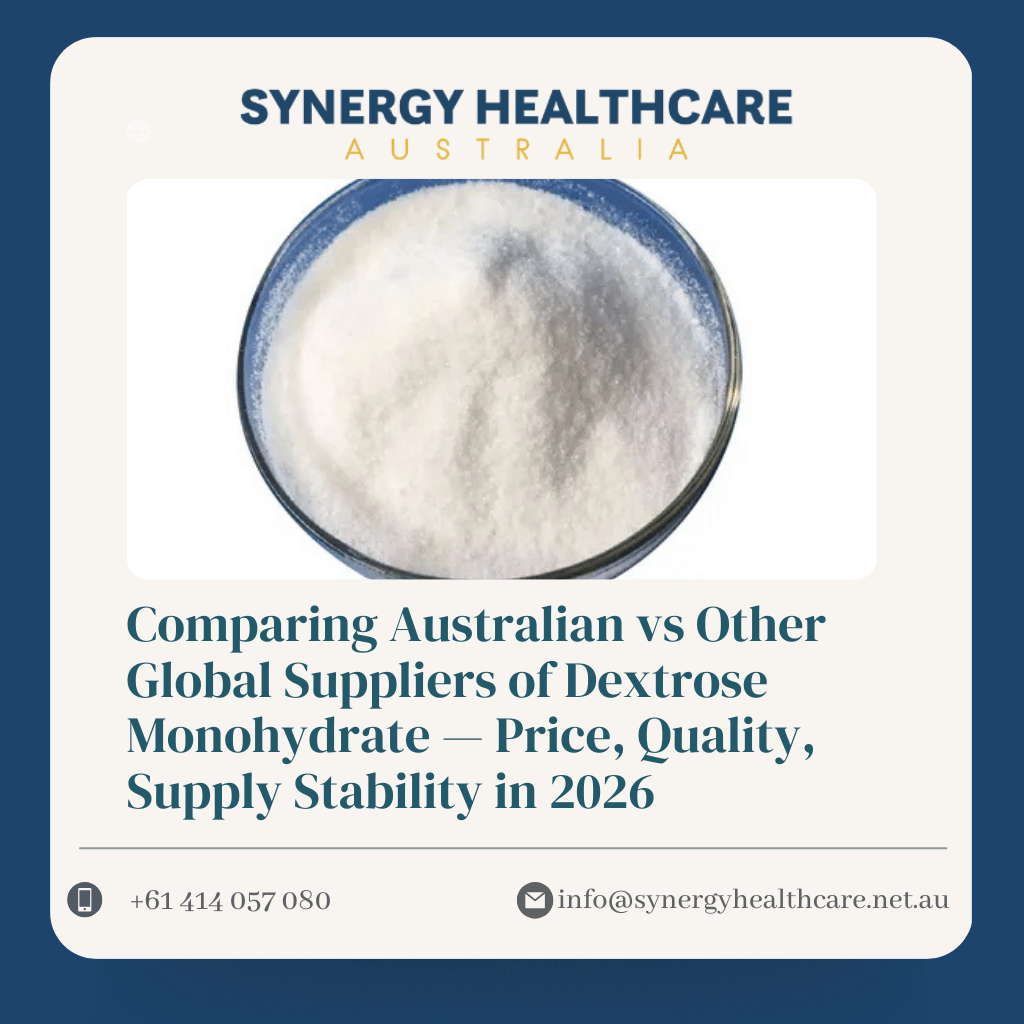
Dextrose monohydrate is a purified form of glucose derived mainly from corn starch. It’s widely used because it’s:
- Easily digestible
- Highly soluble
- Consistent in sweetness and performance
Common applications include:
- Food and beverage manufacturing
- Bakery and confectionery
- Sports nutrition and supplements
- Pharmaceutical formulations
Because it performs consistently across temperature and pH ranges, it remains one of the most reliable carbohydrate ingredients on the market.
📊 Industry insight: Over 70% of Australian processed food manufacturers use some form of dextrose or glucose powder in their formulations.
Overview of the Global Dextrose Monohydrate Market
Globally, dextrose monohydrate is produced at scale in regions such as:
- China
- India
- United States
- Europe
- Australia (via local processing and import-backed supply)
Global demand continues to grow at around 4–5% annually, driven by:
- Sports nutrition
- Convenience foods
- Medical and pharmaceutical demand
However, global supply stability has become increasingly unpredictable due to shipping bottlenecks, energy costs, and geopolitical pressures.
Australian Dextrose Monohydrate Suppliers: Market Overview
Local Supply Model
In Australia, dextrose monohydrate is typically supplied through:
- Local processors
- Import-backed wholesalers with domestic warehousing
This hybrid model allows suppliers like Synergy Healthcare to maintain consistent stock availability without exposing customers to long overseas lead times.
Regulatory Advantage
Australian suppliers must comply with:
- FSANZ food standards
- Allergen declarations
- Traceability and documentation requirements
This significantly reduces compliance risk for manufacturers.
Global Dextrose Monohydrate Suppliers: Regional Comparison
China
- Highly competitive pricing
- Massive production capacity
- Risk factors: quality variation, long shipping times, port congestion
India
- Growing export market
- Competitive pricing
- Inconsistent moisture levels between batches
Europe
- Excellent quality standards
- Higher prices due to labour and energy costs
United States
- Strong quality control
- Expensive freight for Australian buyers
Price Comparison: Australia vs Global Suppliers
Indicative bulk pricing (FOB / landed estimates):
| Supplier Region | Average Price Range (per MT) | Notes |
| Australia | Medium | Stable, predictable pricing |
| China | Low | Hidden freight & re-testing costs |
| India | Low-Medium | Batch variability |
| Europe | High | Premium quality |
| USA | High | Freight heavy |
📊 Reality check: While overseas suppliers may appear cheaper on paper, manufacturers report 15–25% additional landed costs due to delays, customs clearance, re-testing, and stock-outs.
Quality Comparison
Purity and Consistency
Australian suppliers generally provide:
- Food-grade and pharma-grade options
- Reliable batch-to-batch consistency
Overseas suppliers may vary more due to:
- Different processing standards
- Inconsistent corn starch sources
Moisture Content and Particle Size
Moisture consistency is critical for:
- Shelf life
- Powder flow
- Mixing behaviour
Australian-stocked products typically perform better in controlled manufacturing environments.
Supply Stability in 2026
Why Local Supply Matters More Than Ever
Recent disruptions have shown that long supply chains are fragile. Local or locally warehoused supply offers:
- Shorter lead times
- Reduced exposure to shipping delays
- Better demand forecasting
📊 Industry data: Manufacturers using locally stocked ingredients experience up to 40% fewer production interruptions.
Lead Times and Logistics
| Supplier Type | Typical Lead Time |
| Australian suppliers | 2–7 days |
| Asian imports | 6–10 weeks |
| Europe / USA | 8–12 weeks |
For manufacturers running tight production schedules, shorter lead times often outweigh minor price differences.
Sustainability Considerations
Australian manufacturers are increasingly considering carbon footprint and ESG goals.
Local supply offers:
- Lower freight emissions
- Reduced packaging waste
- Better alignment with sustainability reporting
Imported dextrose can carry 3–5× higher transport emissions compared to locally supplied stock.
Which Option Is Better for Australian Manufacturers in 2026?
Australian Suppliers Are Best When:
- Consistency and reliability matter
- Regulatory compliance is critical
- You need fast turnaround
Global Suppliers May Suit When:
- You have long forecasting windows
- You can absorb shipping risks
- Price sensitivity outweighs operational risk
Many manufacturers now adopt a hybrid strategy—primary local supply with offshore backup.
How to Choose the Right Dextrose Monohydrate Supplier
Before choosing a supplier, ask:
- Is the product FSANZ compliant?
- Do you hold local stock in Australia?
- Can you provide COA and traceability?
- How stable is your supply chain?
At Synergy Healthcare, we focus on long-term partnerships—not just transactions.
Conclusion
As we move into 2026, sourcing decisions for dextrose monohydrate suppliers Australia are no longer just about price. They’re about reliability, quality, compliance, and supply security.
Australian suppliers offer predictable supply, regulatory confidence, and faster delivery—making them a strong choice for manufacturers focused on stability and growth.
If you’re looking to future-proof your ingredient sourcing, choosing the right supplier today can save significant cost and risk tomorrow.
FAQs
Q1. Is Australian dextrose monohydrate more expensive than imports?
Not always. When freight, delays, and re-testing are considered, Australian supply is often more cost-effective overall.
Q2. Is locally supplied dextrose food grade?
Yes. Reputable Australian suppliers meet FSANZ food safety standards and provide full documentation.
Q3. Can I buy dextrose monohydrate in bulk in Australia?
Yes. Wholesale suppliers like Synergy Healthcare offer bulk packaging with local warehousing.
Q4. What’s the biggest risk with overseas suppliers?
Supply delays and batch inconsistency, which can disrupt production schedules.
Q5. Who should I work with for reliable supply in Australia?
Trusted suppliers with local stock, technical support, and regulatory expertise—like Synergy Healthcare.