The selection of the appropriate ingredient supplier is not only based on cost and availability, but it also incorporates a complete range of considerations. One should check safety, consistency, compliance, transparency, and a trustworthy supplier. As consumers are scrutinising ingredients closely and authorities are enforcing strict regulations, it becomes essential for manufacturers to collaborate with an industrial food ingredient supplier in Australia who can guarantee both quality and compliance.
No matter if you are producing beverages, baking goods, dairy products, nutritional bars, or processed foods, your supplier plays an important role in your product performance and the brand reputation.
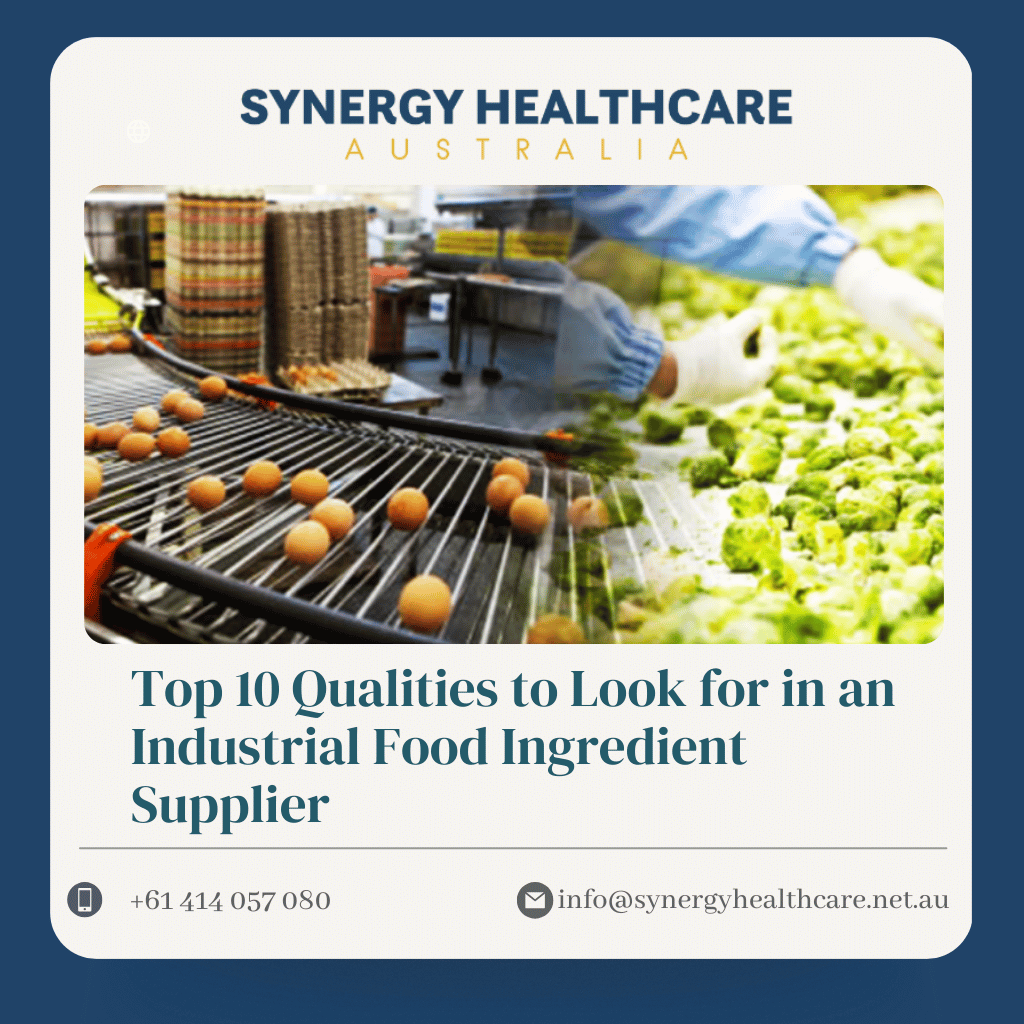
Below are the top 10 qualities to look for while selecting an industrial food ingredient supplier.
1. Proven Industry Experience
A supplier with quite a long history in this industry often brings deeper expertise and problem-solving experience. Suppliers with years of experience can give better ingredient sourcing networks, knowledge of market trends, and the ability to support complex formulations. A reputable Industrial Food Ingredient Supplier in Australia will be able to provide historical data regarding supply chain resilience and innovations in ingredients.
2. Strong Quality Management Standards
A good supplier must follow strict quality standards that consist of HACCP, FSANZ compliance and international certifications. They should be capable of presenting complete documentation that includes COAs (Certificate of Analysis), specifications, MSDS, allergen statements, and traceability proof. This assures the generation of consistent ingredients in every batch.
3. Compliance with Food Safety Regulations
The supplier will have to comply with minimum FSANZ (Food Standards Australia New Zealand) and other international standards such as ISO, GFSI, BRC, or FSSC 22000. A well-established industrial food ingredient supplier in Australia should be able to support the case of gluten-free, vegan, organic, kosher, or halal certification whenever necessary.
4. Traceability and Transparency
Complete traceability from the origin of raw material to the delivery is essential for risk management. The supplier should give full disclosure on the sourcing, production methods, and transport conditions. This facilitates the prevention of contamination, recalls, and compliance violations.
5. Technical and Formulation Support
The ideal supplier is not merely a distributor; they are a knowledge partner. They ought to provide the R&D support, the suggestions for formulations, problem-solving assistance, ingredient optimisation, and application-specific advice. All this support helps the manufacturers to upgrade the texture, the shelf-life, the stability, and the efficiency of the production.
6. Reliable Delivery and Supply Chain Stability
The delay in receiving the necessary ingredients can halt the production process and lead to huge financial losses. It is better to collaborate with suppliers who possess reliable inventory management systems, quick transportation, and smart prediction. The proximity to the local warehouse and regular shipping schedules are significant benefits when buying from a local industrial food ingredient supplier in Australia like us.
7. Sustainability and Ethical Sourcing
The consumers are becoming more and more conscious of the environmental and moral issues. Manufacturers are now considering the suppliers that adhere to the norms of eco-friendly farming, energy-saving processes, and ethical sourcing. A responsible supplier will openly disclose their carbon footprint and pesticide use, and will have the necessary certifications for being labelled as ethical.
8. Competitive Pricing with Value
Price is a factor to consider, but value adds even more weight. Evaluate the total spending of ownership, which comprises quality, testing documentation, technical support, shelf life, and batch reliability. A professional supplier will offer value-based pricing, flexible order sizes, and create tailored solutions for large-scale manufacturers.
9. Strong Customer Support and Communication
The supplier must be able to respond quickly, proactive, and be accessible. It is necessary to have the right communication about the order status, lead times, compliance changes, and requests for custom formulation. Good communication establishes trust and avoids costly misunderstandings.
10. Capability to Scale with Your Business
With an increase in production, you will require a supplier who is capable of growing along with you. One should take care of flexible volume planning, inventory management, forecasting support, and strategic ingredient sourcing that all comply with your growth requirements.
Conclusion
Choosing the most suitable industrial food ingredient supplier in Australia signifies a reliable partnership with a firm that advocates for safety, compliance, transparency, and long-term reliability.
For Australian food manufacturers seeking quality ingredients, Synergy Healthcare is your dependable partner. Our broad selection of products encompasses corn-based products, active pharmaceutical ingredients, and laboratory reagents to serve different industries and applications.
Connect with us today or mail your required ingredients and experience the comprehensive solutions.