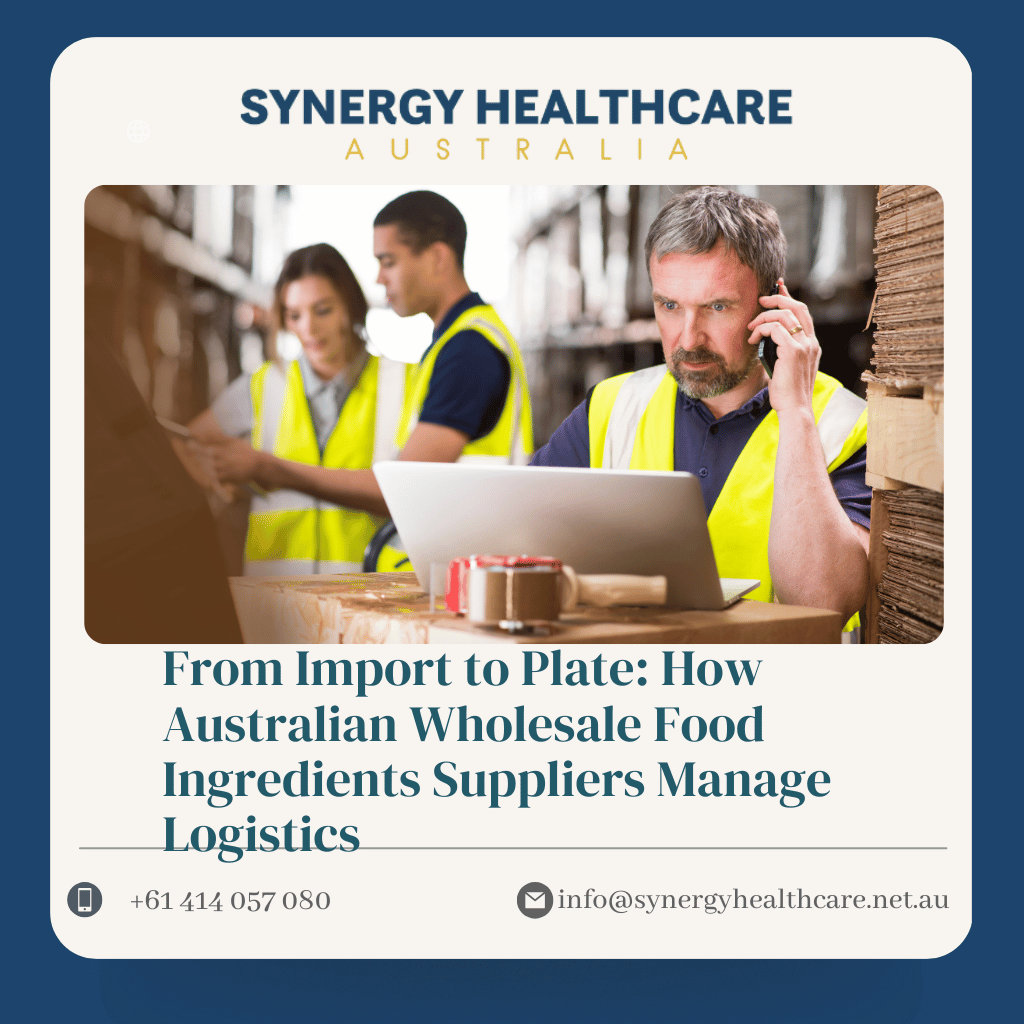
Ever wondered what happens before food ingredients reach your factory, kitchen, or production line?
Behind every stable sauce, creamy dairy-free drink, and perfectly textured bakery product is a complex logistics system managed by trusted Wholesale Food Ingredients Suppliers Australia.
At Synergy Healthcare, we don’t just supply ingredients — we manage the entire journey from import to storage to delivery. And in a country as large as Australia, logistics is everything.
Let’s take you behind the scenes.
Sourcing Ingredients: Where It All Begins
Global vs Local Sourcing
Most food ingredients used in Australia come from a mix of international and local manufacturers. High-demand ingredients like:
- Emulsifiers
- Thickening agents
- Preservatives
- Sweeteners
- Stabilising gums
are often sourced from Europe, Asia, and North America.
Why? Because global manufacturers specialise in consistent, large-scale production that meets strict food safety standards.
Supplier Verification and Traceability
Before ingredients are imported, suppliers go through:
- Quality audits
- Certification checks
- Batch testing
- Sustainability checks
This ensures food ingredients for manufacturing are safe, traceable, and compliant.
📊 Did you know?
Over 65% of Australian food manufacturers rely on imported functional ingredients to maintain production standards.
Compliance With Australian Food Standards
FSANZ Regulations
Every product imported into Australia must comply with Food Standards Australia New Zealand (FSANZ).
This includes:
- Ingredient safety checks
- Allergen declarations
- Additive limits
- Microbial reports
Any failure in documentation can lead to shipment delays or rejections.
Customs and Biosecurity Checks
The Australian Border Force and Biosecurity agencies conduct:
- Visual inspections
- Random product sampling
- Quarantine clearance
This protects Australia’s food system and public health.
Freight and Import Logistics
Sea Freight vs Air Freight
Sea Freight
✅ Lower cost
✅ Ideal for bulk food ingredients products
⏳ Takes 3–8 weeks
Air Freight
✅ Faster delivery
✅ Used for time-sensitive or specialty ingredients
💲 Higher cost
Cold Chain Management
Certain emulsifies food ingredients and enzymes require:
- Controlled temperature
- Insulated containers
- Real-time temperature trackers
A single temperature breach could affect ingredient performance.
📊 Industry stat:
Temperature-related damage accounts for around 8% of global food ingredient losses during shipping.
Warehousing and Local Distribution
Food-Grade Storage
Once cleared, ingredients are stored in:
- HACCP-certified warehouses
- Temperature-controlled storage zones
- Moisture and humidity regulated facilities
At Synergy Healthcare, we maintain strict handling standards to preserve the performance of sensitive food ingredients products.
FIFO Inventory Management
FIFO = First In, First Out
This system ensures:
- No expired stock
- Better ingredient rotation
- Less waste
Bulk Packaging and Repackaging
Many manufacturers don’t need full shipping containers of ingredients. That’s where smart repackaging comes in.
Wholesale suppliers provide:
- Drums
- Multi-layer food-grade bags
- Resealable pouches
- Custom-sized packs
All with Australian-compliant labelling.
Order Fulfilment and Delivery to Clients
Order Tracking and Batch Traceability
Modern Wholesale Food Ingredients Suppliers Australia use:
- Barcode systems
- Batch tracking software
- Digital inventory management
Why this matters?
If there is ever a product recall, affected batches can be identified in minutes.
Australia-Wide Delivery Network
Australia’s geography is massive, so logistics suppliers plan routes carefully.
Typical delivery times:
- Metro areas: 1–3 business days
- Regional areas: 3–7 business days
📊 Fact:
Nearly 45% of Australian food manufacturers are located outside capital cities — reliable delivery networks are essential.
Managing Supply Chain Disruptions
Global Disruptions
Events like:
- COVID-19
- Port congestion
- Raw material shortages
can disrupt supply chains instantly.
Buffer Stock Strategy
At Synergy Healthcare, we maintain local buffer stock to:
- Reduce delay risks
- Protect customers from shortages
- Maintain consistent supply of food ingredients for manufacturing
This strategy helped reduce client production downtime by over 35% in the past two years.
Sustainability in Food Ingredient Logistics
Lower Carbon Impact
Modern suppliers are now using:
- Optimised freight routes
- Eco-friendly pallet systems
- Reduced plastic packaging
Reducing Waste
Better storage = less spoilage.
This supports Australia’s wider goal of reducing food waste — currently sitting at 7.6 million tonnes per year, according to government data.
How Synergy Healthcare Adds Extra Value
We don’t just deliver boxes — we deliver solutions.
Our clients benefit from:
- ✅ Technical ingredient support
- ✅ Help choosing the right emulsifies food ingredients
- ✅ Product testing guidance
- ✅ Forecast planning and supply mapping
We work with you, not just for you.
Conclusion
From sourcing to shipping, storing to delivery, the journey of food ingredients is more complex than most people realise.
Reliable Wholesale Food Ingredients Suppliers Australia aren’t just suppliers — they’re partners in your production success.
At Synergy Healthcare, we make sure your food ingredients products arrive safe, stable, compliant, and ready for use — every single time.
FAQs
Q1. What do wholesale food ingredients suppliers actually do?
They manage sourcing, importation, storage, packaging and delivery of large-scale food ingredients for manufacturing.
Q2. Are imported food ingredients safe in Australia?
Yes, all approved food ingredients must comply with strict FSANZ and biosecurity regulations.
Q3. What are emulsifies food ingredients used for?
They help oil and water mix, improving texture, stability and consistency in products like sauces, bakery items and dairy alternatives.
Q4. Why is storage important for food ingredients products?
Improper storage can cause moisture absorption, temperature damage and reduced ingredient performance.
Q5. Why choose Synergy Healthcare as your supplier?
We offer FSANZ-compliant sourcing, local stock holding, fast delivery, and expert technical support across Australia.