
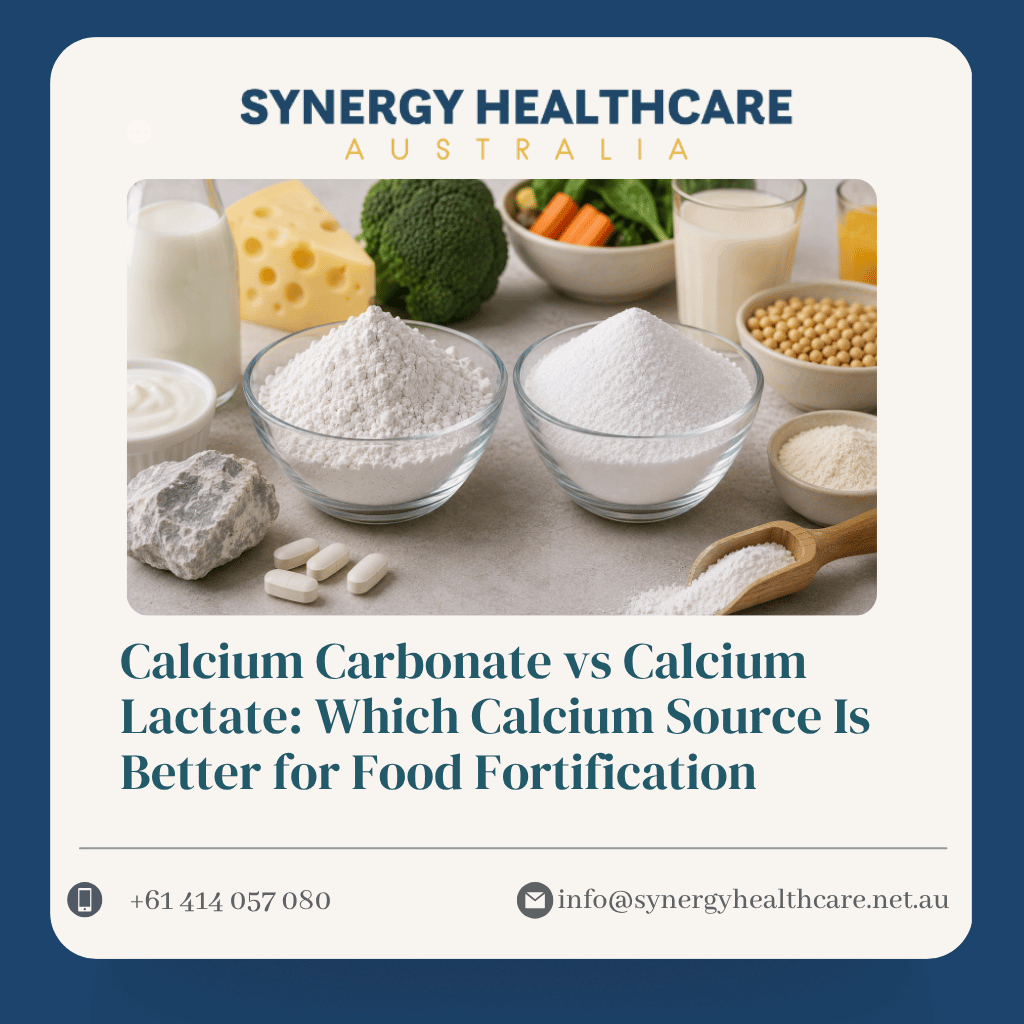
Calcium is one of the key minerals for the purposes of food fortification. This mineral is useful for the food industry to enhance the nutritional benefits of the foods that people consume on a daily basis.
However, selection of the right form of calcium for the purpose of fortification involves more than just considering the content of this mineral. Calcium carbonate and calcium lactate differ in various features, such as the concentration of calcium, solubility, taste, and functionality.
When it comes to Australian food companies, knowing the differences between these forms of calcium will facilitate the process of food production. When selecting among the products from a calcium carbonate supplier, the type of food application matters.
Calcium Carbonate vs Calcium Lactate: What Is the Difference?
Both are calcium salts. Both are permitted fortificants. But their chemistry pulls in different directions.
Calcium carbonate (CaCO₃) ) has a fairly high percentage of calcium and is used extensively in the preparation of food and nutrients. Its water solubility is very low, and this makes it more suited to dry preparations or those in which full solubility is not necessary.
Calcium lactate, on the other hand, is highly soluble and can be beneficial in cases where better dispersibility is needed in food or drinks. But it delivers lower amounts of elemental calcium when compared to calcium carbonate.
The Food Standards Australia New Zealand (FSANZ) Code lists both as permitted calcium sources, subject to food category and use-level rules.
Quick Comparison
| Feature | Calcium Carbonate | Calcium Lactate |
| Elemental calcium | High | Lower |
| Water solubility | Low | Higher |
| Suits dry foods | Excellent | Good |
| Suits beverages | Depends on application | Often preferred |
| Taste impact | Can show if poorly dispersed | Usually cleaner |
| Cost efficiency | Generally favourable | Usually higher per mg calcium |
| Best fit | High-calcium, cost-driven formulas | Solubility-driven formulas |
Why Calcium Carbonate Is Popular in Food Fortification?
The appeal is straightforward: more calcium per gram means less ingredient needed to reach your label claim.
It performs well in:
- Flour and bakery mixes
- Breakfast cereals
- Nutritional powders
- Dry beverage mixes
- Food premixes
- Selected dairy and plant-based products
It’s also generally the more economical calcium salt at scale, which matters once you’re formulating across a full product range rather than a single SKU.
The catch is solubility. In liquid products, poorly micronised calcium carbonate can settle at the bottom of the bottle or leave a gritty edge on the palate. Particle size and dispersion technique end up mattering more than the raw specification sheet suggests.
When Calcium Lactate May Be the Better Choice
Calcium lactate earns its place when solubility and mouthfeel outweigh raw calcium density.
Worth considering for:
- Fortified beverages
- Acidic food products
- Soft foods
- Certain dairy applications
- Formulas where even dispersion is critical
A more soluble source can genuinely simplify formulation in liquid systems. But solubility on its own doesn’t crown a winner; the finished food matrix, processing conditions, pH, and shelf stability all pull weight in the decision too.
Put plainly: calcium lactate isn’t a superior calcium source; it’s a differently suited one.
Bioavailability: Is One Better for the Body?
Bioavailability means the degree to which calcium is absorbable and usable by the body.
It is easy to believe that certain calcium salts are more absorbable than others. However, there are several parameters, including dosage, matrix and other accompanying foods, that determine the extent of calcium absorption.
Studies on calcium fortification demonstrate that the most common forms of calcium salts exhibit comparable levels of fractional absorption under favourable conditions. Even calcium carbonate may possess good bioavailability if taken along with food products.
Thus, food producers cannot rely only on bioavailability when selecting the form of calcium for use in food products. Technological properties of the ingredient are equally significant.
How Should Australian Food Manufacturers Choose?
Rather than asking which calcium source is “better”, ask which one suits the product in front of you.
Run through:
- Product format — powder, solid, dairy, or beverage?
- Calcium target — how much elemental calcium per serving?
- Solubility need — full dissolution or even suspension?
- Taste and texture — any risk to flavour or mouthfeel?
- Processing — heating, drying, high-shear mixing?
- Shelf stability — will calcium stay evenly distributed over time?
- Regulatory fit — is the form permitted for this food category under FSANZ?
Working through this list before formulation starts is far cheaper than discovering the mismatch during a production run.
Common Mistakes to Avoid
Choosing on price alone
The cheapest option can quietly cost more once sedimentation, flavour complaints, or line issues show up.
Ignoring solubility
A calcium source that behaves in a dry mix can act completely differently in a ready-to-drink format.
Fixating on calcium percentage
High elemental calcium is valuable, but it means little if dispersion and stability aren’t sorted.
Skipping pilot trials
Small-batch testing catches pH shifts, texture changes, and appearance issues long before they hit commercial volume.
FAQ
Is calcium carbonate better than calcium lactate for food fortification?
Not universally. Calcium carbonate offers strong elemental calcium and cost efficiency; calcium lactate suits formulations where solubility and dispersion take priority.
Why do manufacturers lean on calcium carbonate?
It delivers a high level of elemental calcium per gram, which works well across most dry food and nutritional formats.
Is calcium lactate more soluble than calcium carbonate?
Yes — noticeably so, which is why it turns up more often in liquid and beverage applications.
What should I ask a Calcium Carbonate Supplier?
Food-grade specifications, purity, elemental calcium content, particle size distribution, certificates of analysis, microbiological testing, and suitability for your specific application.
Can calcium carbonate be used in Australian food products?
Yes, it’s a recognised permitted calcium form under the FSANZ Code, though permission depends on the specific food category and use level worth confirming before formulation begins.
Conclusion
There’s no outright winner between calcium carbonate and calcium lactate, only a better fit for your specific product. Calcium carbonate tends to win on concentration and cost; calcium lactate tends to win on solubility and dispersion.
The smarter move for Australian manufacturers is evaluating the whole food system format, processing, shelf life, and regulatory category, rather than picking a calcium source in isolation.
If you’re sourcing calcium ingredients for a new or existing formulation, talk to a trusted calcium carbonate supplier like Synergy Healthcare about specifications and application fit before locking in your final decision.