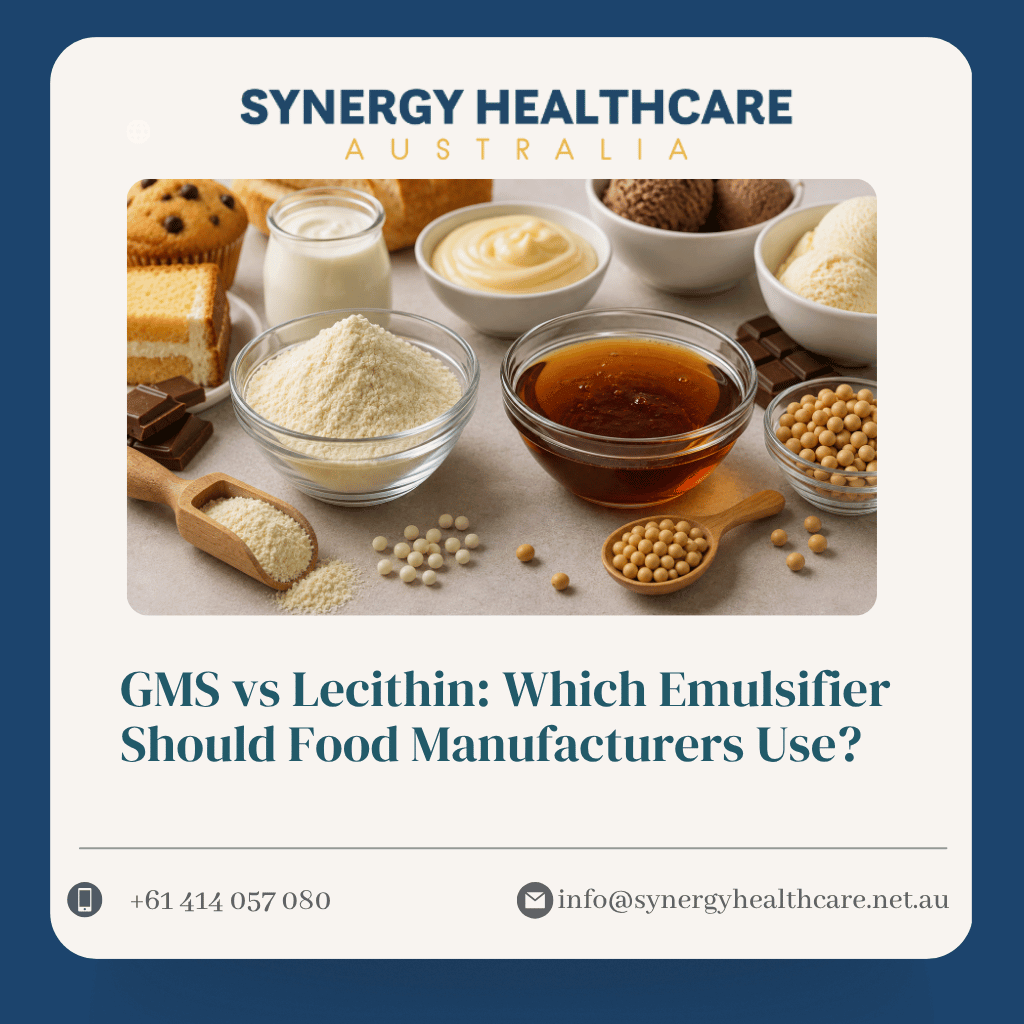
Choosing the right emulsifier can be important in affecting the food product’s texture and stability, including its shelf life. Two of the most common emulsifiers used are GMS (glycerol monostearate) and lecithin.
Both help fats and water play nicely together in a formulation. But they don’t do it the same way, and swapping one for the other without understanding the difference can throw a whole batch off.
Lecithin (INS 322) and mono- and diglycerides of fatty acids (INS 471) are both permitted food additives under the Food Standards Code, but permission isn’t the same as suitability for your product. Let’s understand the difference between GMS and Lecithin: which emulsifier should food manufacturers use?
What Is GMS?
GMS is produced by combining glycerol with stearic acid, giving you an emulsifier that’s particularly good at holding structure. You’ll find it doing heavy lifting in bakery goods, margarine, confectionery, and whipped products.
Its main strength is consistency; it helps distribute fat evenly and keeps a formulation behaving predictably batch after batch.
What GMS typically brings to the table:
- Softer mouthfeel
- Better aeration
- Improved stability
- Finer crumb structure
- Smoother processing
If you’re running a bakery line and crumb consistency keeps you up at night, GMS is usually where formulators look first.
What Is Lecithin?
Lecithin is a naturally occurring phospholipid, most commonly extracted from soybeans, though sunflower and egg-derived versions exist too. Soy lecithin remains the go-to in commercial production because it’s effective, affordable, and flexible across product types.
Where lecithin earns its keep:
- Oil-water dispersion
- Dough handling
- Chocolate flow
- Fat distribution
- Reduced sticking
FSANZ also notes lecithin occurs naturally in foods like egg yolks and soybeans, but once it’s added as a functional ingredient, it needs to be declared clearly on pack, particularly given its soy origin.
GMS vs Lecithin: Key Differences
| Factor | GMS | Lecithin |
| Source | Vegetable or animal fats | Soy, sunflower, or egg |
| Core strength | Texture and structure | Dispersion and flow |
| Bakery role | Crumb softness | Dough workability |
| Chocolate role | Texture support | Viscosity reduction |
| Perception | Technical ingredient | “Natural” association |
| Allergen risk | Depends on source | Soy needs declaration |
Neither one is objectively better. The right call comes down to what your finished product actually needs to do.
When Should Manufacturers Choose GMS?
Reach for GMS when the priority is structure over flow.
Commercial bakeries lean on it for cakes and bread where a soft, even crumb matters more than anything else. It’s also a solid pick when you need an emulsifier that behaves consistently under tightly controlled processing conditions; think continuous lines running at higher temperatures.
Before you commit, though, check the exact specification. Purity, source, and permitted application vary between suppliers, and “GMS” on a spec sheet doesn’t always mean the same thing twice.
When Is Lecithin the Better Choice?
Lecithin shines when versatility matters more than rigid structure.
Chocolate manufacturers use it constantly to cut viscosity and make the mix easier to handle through tempering and moulding. Less product needed to hit the same flow means real savings at volume.
For businesses sourcing a soy lecithin liquid supplier, liquid formats are especially handy where dosing accuracy and easy blending into existing systems matter.
Common uses for liquid lecithin:
- Chocolate coatings
- Bakery mixes
- Margarine and spreads
- Sauces and dressings
- Nutritional formulations
Performance still depends on the phospholipid profile, source, and viscosity of the specific batch, which is exactly why supplier consistency counts for more than people expect.
Australian Food Manufacturing Considerations
Processing performance is only half the equation here. The Australia New Zealand Food Standards Code governs what’s permitted, how it’s labelled, and how allergens are disclosed.
A few things worth locking down before you commit to a supplier:
- Confirm additive permission for your food category
- Declare the correct class name and additive number
- Flag soy-derived lecithin clearly for allergen labelling
- Request documentation and batch traceability
- Check consistency between supplier batches
Australian shoppers are also reading labels more closely than they used to. Supermarket own-brand standards from the likes of Woolworths and Coles increasingly nudge suppliers towards clean, well-documented ingredient lists. A supplier who can back up their spec sheet with real paperwork isn’t a nice-to-have anymore.
How to Choose the Right Emulsifier?
Run through these five checks before placing an order:
- Product type — bakery, chocolate, sauces all behave differently
- Processing conditions — temperature, shear, mixing speed
- Desired outcome — texture, flow, stability, or aeration
- Source and allergens — soy, sunflower, vegetable, or animal
- Regulatory compliance — confirm permitted use under FSANZ
Always run a small pilot trial before scaling up. What performs beautifully in a lab beaker doesn’t always translate cleanly to full production equipment.
Final Verdict: GMS or Lecithin?
There is no clear winner though, it all depends on which one fits your formulation best.
Go for GMS when you want to consider structure, softness, and aeration. Select lecithin when flexibility in emulsification and flow are needed, especially in cases of chocolate and bakery products.
For most Australian manufacturers, the smartest decision blends solid technical performance with dependable compliance, clear allergen management, and a supplier who shows up consistently.
If you’re on the hunt for a reliable soy lecithin liquid supplier, Synergy Healthcare can help you nail down the right specification for your production needs. Get in touch with the team to talk through your formulation and sourcing requirements.
FAQs
GMS vs. lecithin – which is better?
Neither. It just depends on what you want to do with them because each works well in different situations.
Where is liquid soy lecithin used?
Primarily chocolates, baking, spreads, and sauces where dispersion and emulsion is needed.
Can soy lecithin be used in Australia?
Yes, lecithin (INS 322) is an acceptable additive in accordance with the Food Standards Code.
Does GMS contain soy?
Not necessarily; it depends entirely on how it’s manufactured. Always check the supplier’s source documentation.
What should manufacturers check before buying an emulsifier?
Source, purity, technical spec, allergen status, batch consistency, and compliance with FSANZ requirements for your finished product.