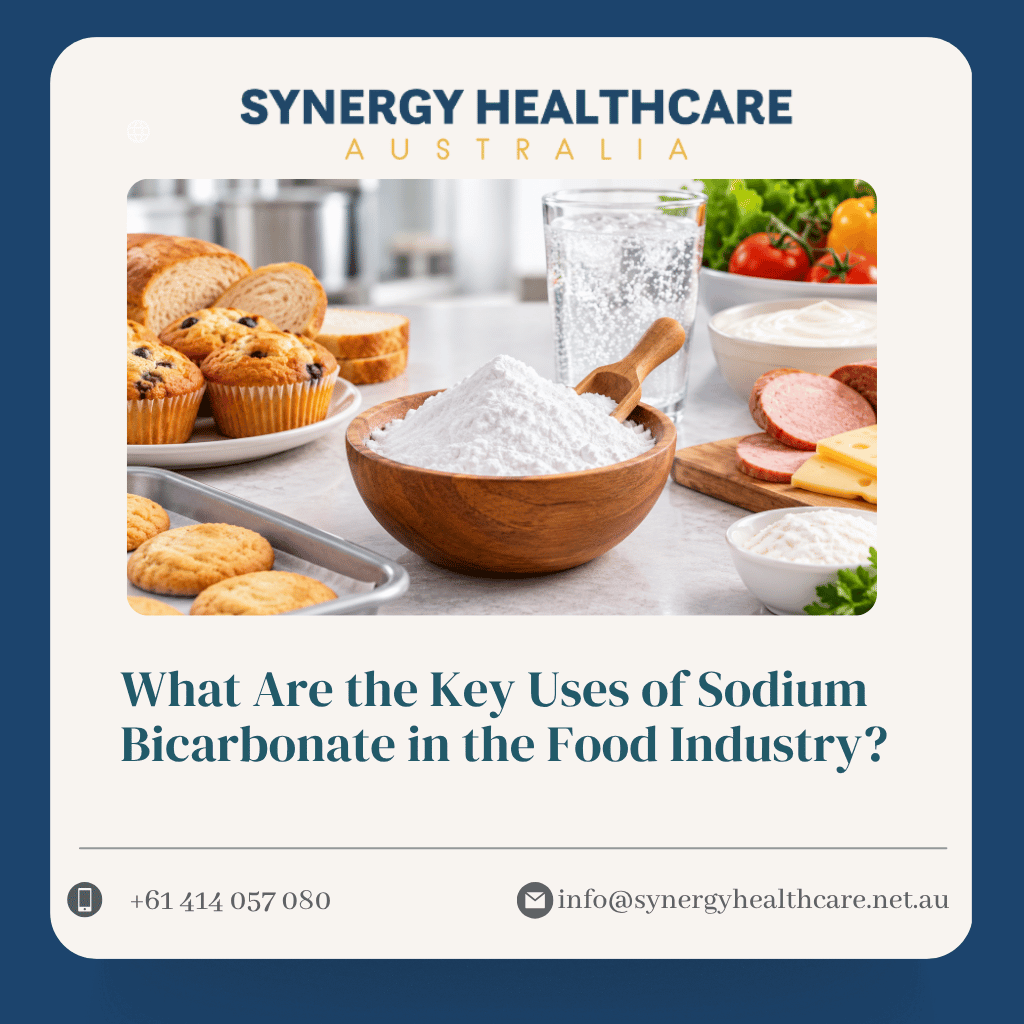
Walk into any commercial bakery and you’ll almost certainly find a bag of sodium bicarbonate sitting on the shelf. Most of us know it as baking soda, but in food manufacturing, it does a lot more than just help cakes rise.
In case you need to source this product for your business, finding a reliable sodium bicarbonate supplier is not something that you should hurry with. Purity, uniformity, and right certification have an effect on the outcome of your product.
But what is the role of sodium bicarbonate in food processing? Let’s see its key uses one by one.
What Is Sodium Bicarbonate Used for in Food Production?
The basic function of sodium bicarbonate is to work as a leavening agent, acidifier, and processing agent. When it meets an acid, it releases carbon dioxide, and that reaction is behind a surprising number of everyday foods.
You’ll typically find it in:
- Bread
- Cakes and muffins
- Biscuits
- Crackers
- Confectionery
- Some beverages
How much gets used really comes down to the recipe and what result the manufacturer is after.
1. Baking and Leavening
This is the use most people already know. Baking soda reacts with acidic ingredients like buttermilk, cocoa, or yoghurt, and that reaction produces carbon dioxide gas.
As the food bakes, those gas bubbles expand, giving the product a lighter, airier texture.
It shows up in:
- Cakes
- Muffins
- Cookies
- Biscuits
- Pancakes
- Quick breads
Think of a batch of biscuits: get the sodium bicarbonate ratio right, and they come out light and crisp. Add too much, though, and you’ll notice a bitter, soapy aftertaste nobody wants.
2. Controlling Acidity and pH
Getting the acidity right matters more than most people realise. It affects taste, texture, colour, and fluidity during the processing of the product.
Sodium bicarbonate assists in ensuring that the pH level is within the required levels when necessary.
Such control can:
- Ensure that taste is balanced
- Stabilise the product
- Ensure batch consistency
- Avoid any processing problems
When dealing with companies producing on massive production lines, such consistency is not an added advantage but a requirement.
3. Improving Food Texture
A product is usually made or ruined by the texture it carries. Sodium bicarbonate definitely comes into play, particularly when making baked products.
This reaction produces bubbles of carbon dioxide within the mixture; therefore, determining the texture of the final product.
Depending on the recipe, this can lead to:
- Softer crumb
- Better tenderness
- More volume
- Lighter mouthfeel
For commercial bakeries producing thousands of units a day, this kind of texture consistency is genuinely hard to achieve without the right ingredients.
4. Supporting Browning in Baked Foods
Just like taste, colour is an important factor in customer preference. Sodium bicarbonate may have an effect on the browning of baked products.
A slightly more alkaline environment tends to encourage browning reactions, which is part of why biscuits and cookies get that golden look people expect.
That said, browning shouldn’t be chased by simply adding more baking soda. Overdo it, and you’ll throw off both the flavour and the final appearance.
5. Use in Biscuits, Crackers and Snacks
The snack food industry relies on sodium bicarbonate quite heavily, particularly where controlled expansion and texture are important.
In crackers, it can shape the final crunch and structure. In cookies, it often affects how much they spread and how crisp they end up.
But it’s never used in isolation. Flour type, moisture levels, sugar content, and fat all interact with sodium bicarbonate to determine the outcome, so the whole recipe needs to be considered together.
6. Helping Maintain Consistent Food Production
Large-scale manufacturing runs on repeatability. A product needs to taste and perform the same way this week as it did last month.
Reliable, food-grade sodium bicarbonate supports that consistency, but only when it’s properly specified and stored.
Things to watch out for:
Food grade specifications
Purity standards
Quality of packaging
Storage conditions
Consistency of batches
Reliability of the supplier
And that’s precisely why it becomes critical for food companies to choose a good sodium bicarbonate supplier.
What Should Food Manufacturers Check Before Buying?
When sourcing an ingredient like this, more than price is involved. There are a couple of things you should consider before going ahead with a supplier.
1. Confirm Food-Grade Quality
Verify that the product that you are buying is indeed food-grade to suit your particular application.
2. Check Product Consistency
Quality consistency makes formulation much easier and removes a great deal of uncertainty from manufacturing processes.
3. Review Packaging and Storage
Sodium bicarbonate needs to stay dry. Poor packaging or storage can quietly affect how it performs down the line.
4. Ask About Documentation
Depending on your industry, you may need specification sheets, certificates of analysis, or other quality paperwork on hand.
Common Mistakes When Using Sodium Bicarbonate
Even experienced manufacturers slip up here occasionally.
Using too much — this leads to a bitter, soapy taste and can throw off the colour too.
Ignoring recipe acidity — baking soda needs an acidic partner ingredient to actually work properly.
Poor storage — moisture exposure changes how the ingredient handles and performs.
Buying on price alone — cheaper stock often means less consistency and missing documentation.
FAQ’s
1. Why is sodium bicarbonate used in the food manufacturing process?
The use of sodium bicarbonate is primarily for leavening, pH control, acid control, texturing and browning of foods like bread, biscuits, crackers, and snacks.
2. Is sodium bicarbonate and baking soda the same thing?
Yes, baking soda is its common name. However, in the process of manufacturing, you will require its food-grade form.
3. How does the sodium bicarbonate make the baked item to rise?
The sodium bicarbonate combines with the acid to produce carbon dioxide, allowing it to expand while it is being baked.
4. How do I select a good sodium bicarbonate supplier?
Select a sodium bicarbonate supplier that can ensure food-grade quality, packaging, specification, and documentation of the product.
5. Could excess use of sodium bicarbonate affect the quality of food?
Of course, excess use of sodium bicarbonate will make food have a bitter taste and change its colour or texture; hence, measuring has to be exact.
Conclusion
Sodium bicarbonate appears like a basic ingredient, but it serves many significant purposes in the production of foods, such as acting as a leavening agent. This is in addition to aiding with texture, colour, and balancing of the pH levels of the ingredients.
In Australia, working with an experienced sodium bicarbonate supplier is one way of ensuring that you have taken a huge step towards success in your operations. Synergy Healthcare can assist your company in finding a suitable food-grade product. Contact us today.