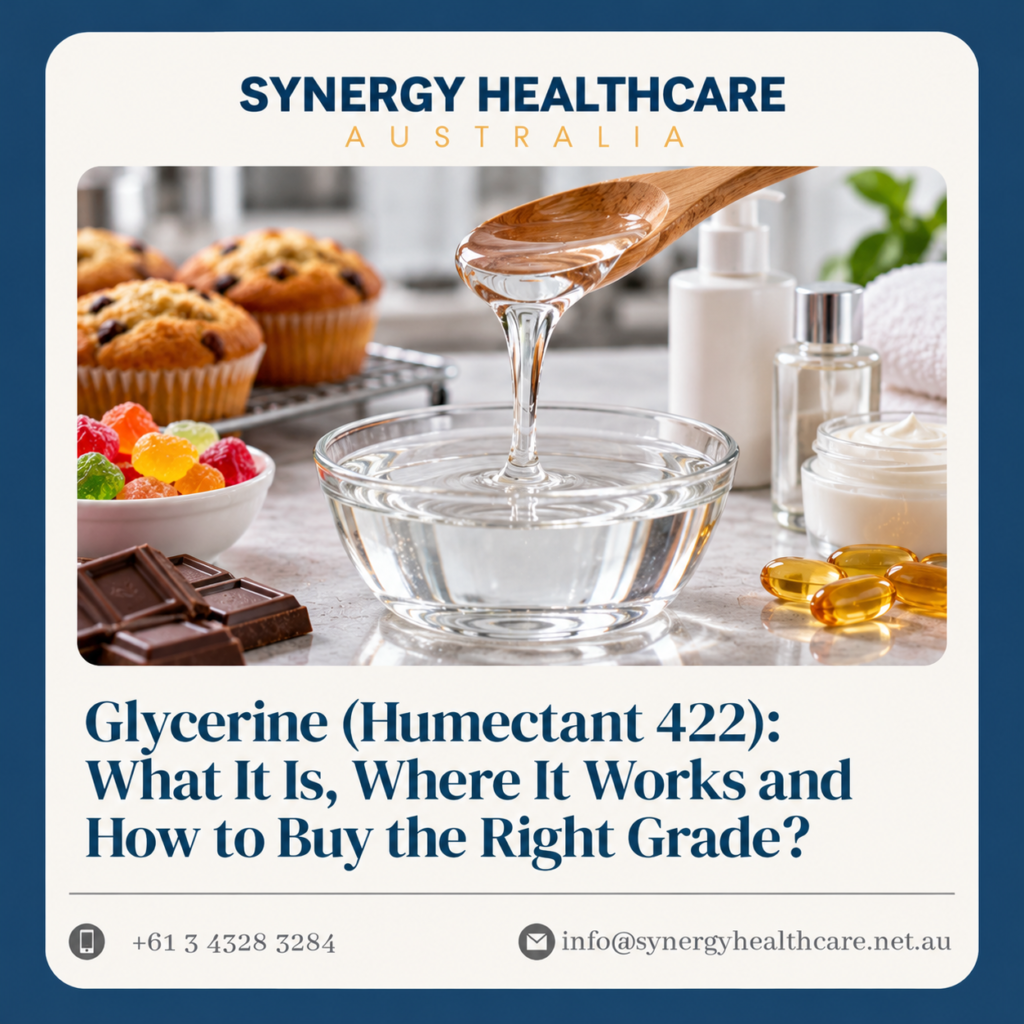
Your muesli bar is still chewy on day 90 for the same reason a cough syrup pours smoothly and a moisturiser leaves skin soft. One ingredient is doing all three jobs.
Glycerine, also spelled glycerin and chemically named glycerol, is a clear, odourless, sweet-tasting liquid that attracts and holds water. Food labels in Australia list it as humectant (422). Pharmaceutical and cosmetic makers use the same molecule as a solvent, moisturiser and excipient, in purer grades.
Glycerine, Glycerol, Glycerin or 422?
They are all the same compound (CAS 56-81-5). “Glycerol” is the chemist’s name, “glycerine” and “glycerin” are trade spellings, and 422 is its international additive number. Europe prints it as E422. Under the Food Standards Code, Australian labels show the class name followed by the code or the name, so you will see “humectant (422)”, “humectant (glycerol)” or simply “vegetable glycerine”.
Where Does Glycerine Come From, and Why Grade Matters?
Glycerine is released when fats and oils are split into fatty acids or turned into soap. Biodiesel production also creates it: roughly 10% of output by weight comes out as crude glycerol, at only 60% to 80% purity. Refining removes the water, salts and residues, and that refining step is what separates the grades:
- Crude glycerol (60% to 80%): A feedstock for refiners, never an ingredient.
- Technical or industrial grade: Fine for resins, antifreeze and cleaning products. Keep it out of anything people eat or apply.
- Refined USP, BP or EP grade: Typically sold at 99.5% purity or higher, and the standard choice for food, pharmaceuticals and cosmetics.
- Origin-specific grades: Vegetable, palm-based (with RSPO certification if you need it), kosher or halal, each backed by its own certificate.
What Glycerine Does in a Formula?
- Food: Keeps bars, wraps and cakes soft for months, carries flavours and colours, and adds mild sweetness and body.
- Pharmaceuticals: Acts as a solvent and sweetener in oral liquids and as a base for suppositories.
- Cosmetics: Draws water into the skin, which is why it sits near the top of so many cream, serum and cleanser labels.
- Laboratories: Protects bacterial stocks stored at minus 80°C as a cryoprotectant.
What 223 Australian Labels Say About 422?
We pulled the ingredient lists of 223 products sold in Australia from the Open Food Facts database on 19 October 2026, across protein bars, muesli bars, cakes, wraps and dried fruit. Then we searched every label for glycerol and three other common humectants: sorbitol (420), maltitol (965) and propylene glycol (1520).
- Bars run on glycerine: It appears in 74% of protein bars and 52% of muesli and cereal bars, against 33% of wraps, 16% of cakes and 4% of dried fruit. The only dried fruit using it was sweetened dried cranberries.
- It is the default humectant: Of the 91 products using any of the four humectants, 84 (92%) use glycerol. Sorbitol appears on 19 labels, and 14 of those pair it with glycerol.
- Low-sugar bars stack their polyols: 46% of protein bars also contain maltitol. Sugar comes out, polyols go in, and glycerol keeps the bite soft.
- The name beats the number: 76% of the labels print glycerol, glycerine or glycerin instead of “422”. Brands appear to bet that shoppers trust a word more than a code.
- Origin is becoming a selling point: 19% of the glycerine labels state where it came from: 13 say plant-derived or vegetable, and 3 say palm.
Image: humectant-422-label-study-chart.png. Alt text: Bar chart showing the share of 223 Australian products listing humectant 422 by category; protein bars 74%, muesli bars 52%, wraps 33%, cakes 16%, dried fruit 4%.
If you make bars, wraps or soft bakery, glycerine is a structural ingredient, not an optional extra. Your customers also want to know where it came from, so origin documentation now matters as much as purity.
Six Checks Before You Buy Glycerine
- Match the grade to the end use: Pharmaceutical work needs USP, BP or EP glycerine; food needs a refined grade that meets food additive specifications; cosmetics need cosmetic or pharmacopoeia grade.
- Read the assay on every certificate of analysis (COA): Refined grades are typically 99.5% or higher, and the figure should come from that lot, not a brochure.
- Ask for diethylene glycol (DEG) and ethylene glycol (EG) results: DEG and EG contamination of syrup ingredients was linked to the deaths of more than 300 children in 2022. In May 2023 the US FDA told drug makers to test every container of every lot of high-risk ingredients, glycerin included, against a 0.10% limit.
- Get the origin in writing: Vegetable, animal or synthetic, plus palm and RSPO status, must match any vegan, halal, kosher or palm-free claim on your pack.
- Know who made it: A good COA names the original manufacturer, not just the distributor who relabelled the drum.
- Plan the logistics: Bulk glycerine usually ships in 250 kg drums or 1,000 kg IBCs, and it thickens noticeably in a cold warehouse, so allow for pumping and dosing.
Is Glycerine Safe to Eat?
Yes, within normal use. The Joint FAO/WHO Expert Committee on Food Additives (JECFA) gave glycerol an acceptable daily intake of “not specified” in 1976 and kept it in 2001. That is the regulator’s way of saying no numerical limit is needed at the levels foods use. Food Standards Australia New Zealand permits it as additive 422.
Frequently asked questions
- Is glycerine the same as propylene glycol?
No. They are different molecules that do a similar job. Propylene glycol (1520) turned up on just 5 of our 223 labels, all of them cakes.
- How should bulk glycerine be stored?
Keep containers sealed, dry and at room temperature. Glycerine pulls moisture from the air, so an open drum slowly dilutes itself.
Our Advice is to Source Glycerine You Can Document
Synergy Healthcare supplies glycerin (glycerol) in BP and USP, cosmetic and reagent grades from our Melbourne and Sydney warehouses, with a COA on every order. Tell us your application and target spec, and we will match the grade and the paperwork.
Download the free Glycerine Buyer’s Spec Sheet, then request a quote for your next production run.