
Flour changes with every harvest. Your customers expect the same loaf every Tuesday. Bread improver is how commercial bakers close that gap.
Bread improver is a pre-mixed blend of functional ingredients that makes dough stronger, more tolerant of the production line and slower to stale once baked. Most blends combine an emulsifier such as SSL (481), enzymes such as fungal amylase and an oxidising agent such as ascorbic acid (300), carried on flour.
What Does Bread Improver Actually Do?
- Builds Dough Strength: So dough survives high-speed mixing, dividing and long proofs.
- Traps More Gas: This means better volume and a finer, more even crumb.
- Slows Staling: So the loaf is still soft on day four, not just day one.
- Smooths Out Variation: Between flour deliveries, seasons and shifts.
What is Inside a Bread Improver?
Each ingredient has one job. Good blends combine three or four of them.
- Emulsifiers: Sodium stearoyl lactylate (481) and DATEM (472e) bind to gluten and lift volume. Mono and diglycerides (471) bind to starch and keep the crumb soft. Lecithin (322) is the gentler, label-friendly option.
- Enzymes: Fungal alpha-amylase feeds the yeast and improves crust colour. Xylanase makes dough more extensible, which matters most in wholemeal and high-fibre breads.
- Oxidising agent: Ascorbic acid (300) tightens the gluten network so the dough holds its shape in the tin.
- Reducing agent (optional): L-cysteine (920) relaxes tough doughs and shortens mixing time.
- Carriers: Soy flour, malt flour and wheat flour dilute the actives so they can be weighed accurately and spread evenly.
A typical Australian retail improver lists emulsifier 481, soy flour, flour treatment agents 516, 300 and 920, malt flour and amylase. Five functions, one scoop.
What 103 Australian Bread Labels Reveal?
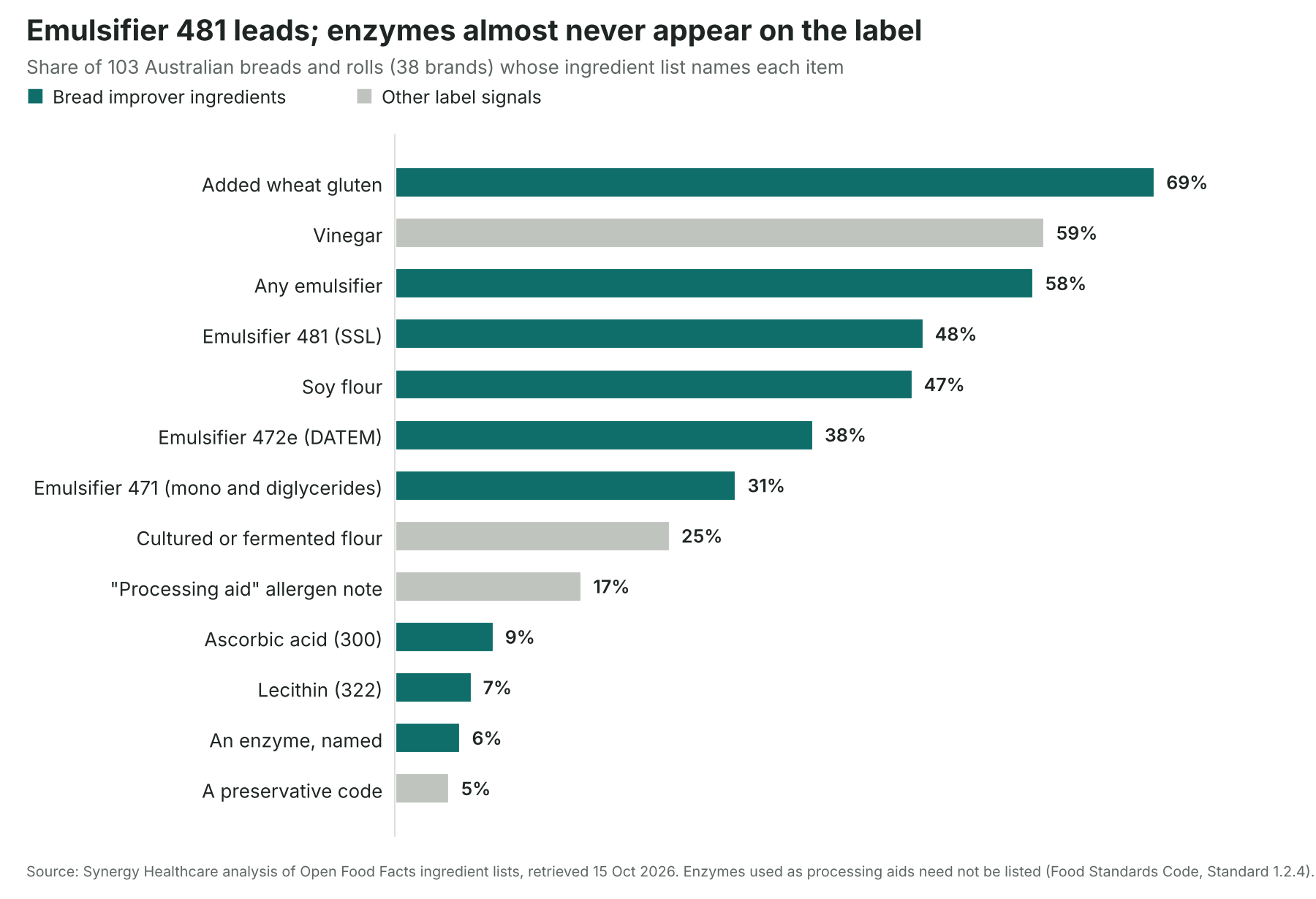
We pulled the ingredient lists of 103 wheat and rye breads and rolls sold in Australia, across 38 brands, from the Open Food Facts database on 15 October 2026. Then we checked every label for improver ingredients.
- 58% list at least one emulsifier: Emulsifier 481 leads, appearing on 48% of all labels and on 82% of the loaves that use any emulsifier.
- Stacking is standard: 43% combine two or more emulsifiers, and 23% run the full 471, 472e and 481 trio. Plant bakeries layer them because each one solves a different problem.
- Dough boosters sit outside the improver too: 69% add wheat gluten and 47% add soy flour.
- Preservatives have gone undercover: Only 5% declare a preservative code, yet 61% use vinegar or a cultured or fermented flour to slow mould. Same job, friendlier label.
- Enzymes are nearly invisible: Just 6% name an enzyme. That is a labelling rule, not a rarity: Standard 1.2.4 of the Food Standards Code does not require processing aids to appear in the ingredient list. The 17% of labels showing “processing aid (wheat)” are declaring an allergen, not revealing the recipe.
- Clean label is a real segment: 30% of the breads carry no additive codes at all.
The lesson for manufacturers: emulsifiers are the half of your improver that shoppers can read, and enzymes are the half they never see but always notice in the crumb.
How Much Bread Improver Should You Use?
- Complete improvers: Commonly dosed at about 1% of flour weight, or 10 g per kilogram of flour.
- Concentrates: Dosed lower, so the supplier’s technical data sheet (TDS) is the only number that counts.
- Your own blend: Dose each component separately, because enzyme activity varies between suppliers and even between batches.
More is not better. Excess amylase gives a sticky, gummy crumb, and excess ascorbic acid makes dough tight and reluctant to rise.
Popular Bread Improver Substitutes Available in Australia
Australians search for a bread improver substitute about 1,000 times a month, more than 40% of the volume of “bread improver” itself. These swaps each cover one job:
- Vital wheat gluten adds protein and structure to wholemeal and seeded doughs.
- Ascorbic acid in a tiny pinch strengthens the dough.
- Lecithin softens the crumb and extends shelf life with a simple label.
- Diastatic malt flour supplies natural amylase for colour and fermentation.
- Time is a long, cold fermentation builds strength and flavour for free. It just costs you hours.
A substitute fixes one problem. A complete improver fixes four at once, which is why high-volume lines rarely go without one.
When to Skip Using Bread Improver?
Long-fermented sourdough and rustic, open-crumb loaves rarely need an improver. Sandwich loaves, rolls, burger buns and anything sliced and bagged are where improvers earn their keep, because consistency is the product.
Buying Improver Ingredients in Bulk: a Five-point Checklist
-
Match function to product
Softness points to 471 and 481, volume to 472e and xylanase, tolerance to ascorbic acid.
-
Decide your label first
Choose between a code-friendly blend and a clean-label build of enzymes, lecithin and malt.
-
Check allergens
Soy flour and soy lecithin both trigger a soy declaration.
-
Demand paperwork
Ask for a certificate of analysis (COA) with every batch and a TDS that states dosage and enzyme activity.
-
Trial one change at a time
Bake side by side and judge on day three, not day one.
Frequently Asked Questions
- Is bread improver the same as yeast?
No. Yeast makes the gas. Improver helps the dough hold it.
- Is bread improver vegan?
Usually, but check the emulsifiers. 471 and 472e can come from animal or vegetable fats, which is why many labels specify “vegetable emulsifier”.
Build a Better Loaf, From the Ingredients Up
Synergy Healthcare supplies the building blocks of bread improver in bulk from our Melbourne warehouse: fungal amylase, amylase and xylanase blends, SSL (481), GMS (471), ascorbic acid, soy lecithin, vital wheat gluten and calcium propionate, with a COA on every order.
Download the free Bread Improver Cheat Sheet, then request a quote and tell us what you bake. We will help you build the blend.