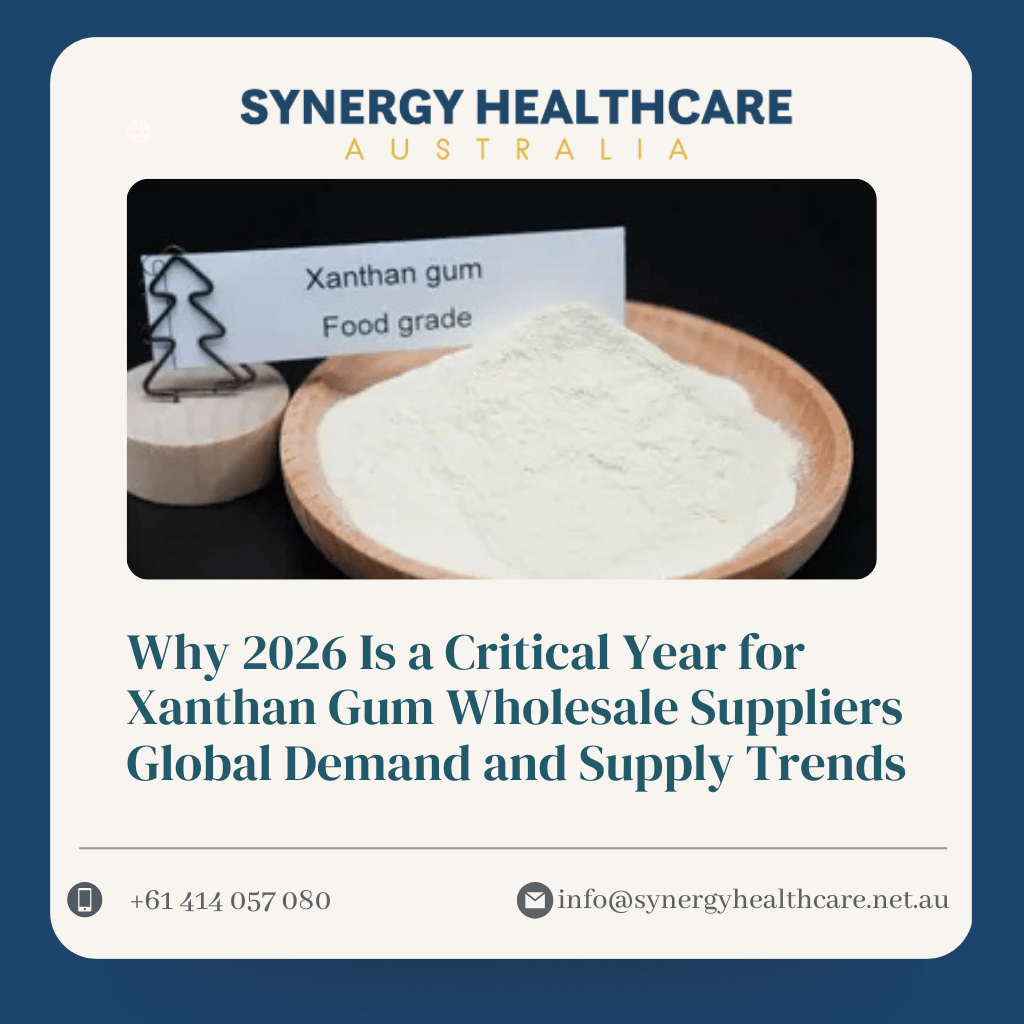
With 2026 just around the corner, shifting global demand and increasingly restricted supply chains are leading to price adjustments at a crucial moment for the food ingredient industry. This will be a very critical time for food manufacturers and formulators in Australia.
Quality, price, and supply will be standard for those who plan, while others might experience unpredictability and uncertainty as market volatility intensifies. The blog will discuss why 2026 will be a turning point for xanthan gum sourcing and what the implications are for choosing the right xanthan gum wholesale suppliers in the years ahead.
A Market Approaching an Inflection Point
Xanthan gum is one of the most reliable hydrocolloids utilised in modern food processing with the potential to enhance stability, thickness, and texture across temperature and pH ranges. Mordor Intelligence (2024) reports that the xanthan gum market in the Asia-Pacific region alone is expected to grow at a CAGR of nearly 5.8% until 2030, and food and beverage applications are the main driving force behind this growth.
In its global survey, Grand View Research foretells the market’s total value will surpass USD 1.8 billion by 2026, with food ingredients claiming more than 60% of the consuming share.
This issue is pertinent to Australia since more than 70% of the xanthan gum consumed in food production and imported, mainly from Asia. Due to the increase in demand, the criteria for selecting suppliers are shifting from price to the sustainability of the supply chain.
Why Demand Is Accelerating Faster Than Supply
Xanthan gum demand is being successfully driven upward by several structural forces:
- Clean-label reformulation: Australian consumers are gradually demanding gluten-free, vegan and non-additive-transparent products. Xanthan gum fits these needs as a fermentation-derived, plant-based stabiliser.
- Increase of convenience foods: According to Statista (2024), the segment of ready-to-eat and ready-to-cook food in Australia is growing by more than 6% per year. As a result, it increases the demand for stabilisers that keep the texture and extend the shelf life.
- Growth of functional foods: From protein beverages to low-fat dairy alternatives, Xanthan gum is the backbone of functional foods. It enables mouthfeel without compromising nutritional positioning.
On the supply side, the production capacity is still heavily concentrated. China alone produces almost 65% of the total global output (International Trade Centre, 2024), making the market quite vulnerable to changes in policies, power, and farming practices in that specific area.
Pricing Pressures Heading into 2026
Since 2023, there has been a clear and strong volatility in xanthan gum prices. If we look at the breakdown of industry costs, we will see that corn starch is the largest component, making up almost 60% of production costs. While energy and wastewater treatment account for another 25%. World Bank commodity data (2024) shows that corn price fluctuations are a result of climate change and are a major factor in raising the cost of fermentation-based ingredients already.
Analysts have predicted that the prices will stabilise between USD 2,500–3,000 per metric tonne in 2026, which is a big hike from the price of about USD 2,100 in 2023 (Allied Market Research, 2024). This situation for the Australian buyers emphasises the necessity of establishing a long-term partnership with xanthan gum wholesale suppliers who can provide forward contracts and a variety of sources.
Supply Chain Realignment: What’s Changing
The period leading to 2026 involves a silent restructuring of supply chains:
- Manufacturers are shifting from single-origin sourcing to a diversified sourcing strategy to protect themselves against export controls and logistics disruptions.
- There will be an increasing need for food-grade materials with certification, including the provision of Halal, Kosher, ISO 22000, and FSANZ-compliant documentation for Australia.
- Buyers expect shorter lead times and prefer support of regional warehousing to long spot purchases.
Suppliers that operate purely as traders are losing ground to the integrated distributors who combine technical knowledge with the reliability of logistics.
Why 2026 Matters Specifically for Australian Buyers
The food manufacturing industry in Australia adds over AUD 165 billion every year to the country’s economic output (Australian Bureau of Statistics, 2024). With the increasing sales of processed foods, it becomes essential to comply with regulations and maintain uniformity. A hydrocolloid supply interruption will immediately impact the production schedule and contract fulfilment.
This is the point where the seasoned xanthan gum wholesale suppliers exhibit their superiority. They guarantee food-grade quality, deal with cross-border regulations, and withstand the fluctuations of the world market.
Technology and Quality Expectations Are Rising
By the year 2026, the suppliers will be evaluated not only on their price but also on how transparent their processes are. The use of fermentation control, AI-based monitoring, and IoT-driven quality assurance is a major development that is contributing to the improvement of purity and performance consistency. McKinsey Chemicals Insights (2024) reports that the digital process optimisation can lower the batch variability measure (15% ), which is very critical for the food industry.
Nowadays, the Australian manufacturers are asking for customised mesh size, shear stability data, and application-specific technical support. These needs can only very well-established suppliers can provide a large scale.
Strategic Outlook for Suppliers and Buyers
The takeaway is clear: 2026 will reward those who are ready. It will be the buyers who seal the deals with dependable xanthan gum wholesale suppliers who will reap the benefits of stable prices and ongoing technical support. Suppliers who invest in diversified sourcing, compliance, and customer support will seize the long-term contracts instead of spot sales.
Start Positioning for 2026
The road to 2026 is already shaping the xanthan gum landscape.
Increased worldwide demand, production limited to very few places, and stricter quality standards imply that both suppliers and customers have to adapt and change early. For the Australian food industry, it is important to collaborate with a distributor who is well-versed in the global supply dynamics and the local regulations.
Synergy Healthcare is one of the best xanthan gum wholesale suppliers you are willing to shake hands with. We are ready to support those companies that need trustworthy, food-grade solutions from the most acknowledged xanthan gum wholesale suppliers in Australia.
Partner with Synergy Healthcare and discover how our ethical sourcing goes hand in hand with future-ready food ingredients.